
Picture the scene. You’re at a braai. Someone, let’s call him Danie, is on his third boerewors roll with the white bread bun, and you make the mistake of mentioning that maybe seed oils aren’t doing anyone any favours. Danie puts down his Castle, gives you the look, and says: “Ag, come on. People are living longer than ever. If our food was so terrible, we’d all be dropping dead younger, not older.”
Danie is not stupid. Danie is repeating an argument that sounds completely logical on the surface. It is the single most common defence of the modern diet you will ever encounter.
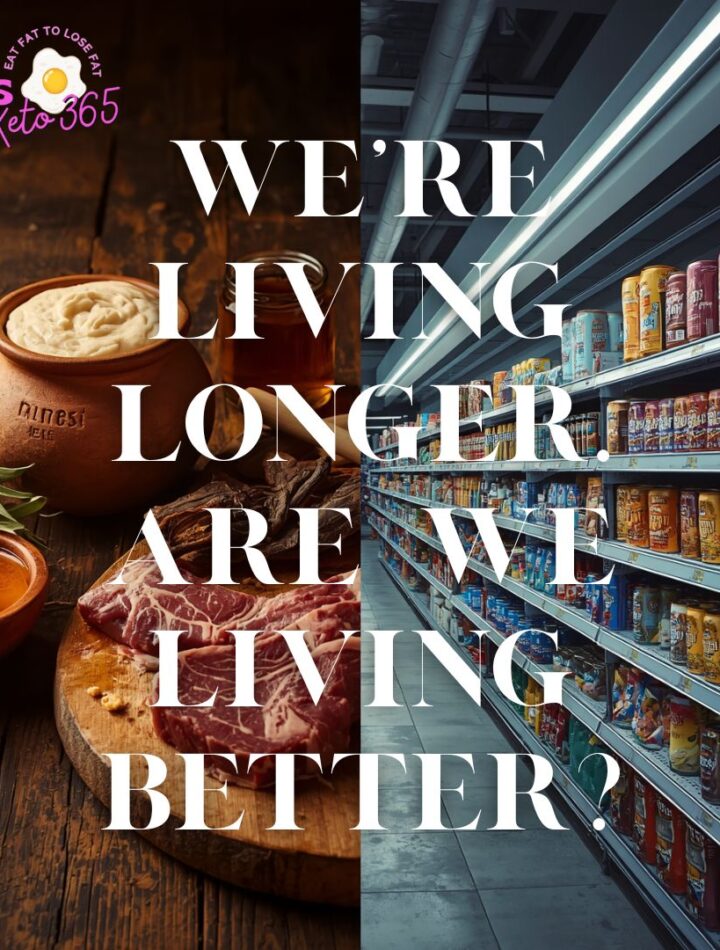
We’re living longer. Therefore, modern food cannot be making us sick. Right?
Wrong. The data, not the wellness industry, not Instagram, not your yoga teacher, the actual peer-reviewed, Statistics South Africa, World Health Organisation data, tells a very different story.
Buckle up, because we’re about to do something dangerous. We’re going to actually look at the numbers and ask the question Danie hasn’t thought to ask… longer, yes. Healthier?
South Africa in 1905: What Did Life Actually Look Like?
Let’s set the scene. It’s 1905. You’re living in what will soon become the Union of South Africa. Your diet, depending on who you are and where you live, looks something like this:
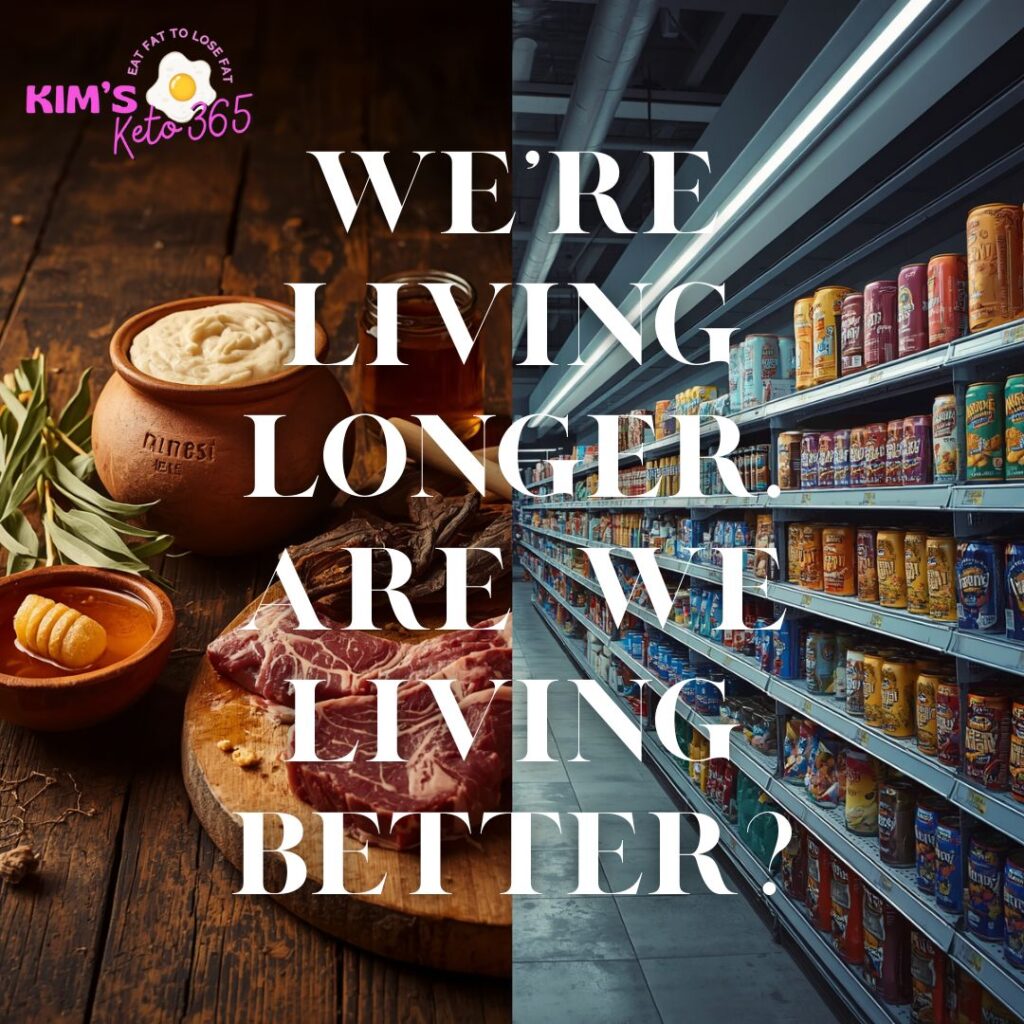
If you’re Zulu or Xhosa, you’re eating fermented milk (amasi), sorghum, maize, morogo (wild leafy greens), beef, goat, and organ meats. Your fat comes from animals. Your food is whole, unprocessed, and often fermented. Khoisan communities are hunting game and gathering roots, berries, and tubers. Sotho people are eating pap made from sorghum and millet, slow-cooked stews, and seasonal vegetables. If you’re an Afrikaner on a farm, it’s potjiekos, biltong, melktert made with real cream, and boerewors cooked over a wood fire.
What is nobody eating in 1905?
Canola oil. Sunflower oil. Margarine. Anything in a foil packet with seventeen ingredients. High-fructose corn syrup. Artificial food colouring. Plant-based “meat” held together with methylcellulose. Breakfast cereals telling you they contain “essential vitamins” (added back after stripping the originals out). UHT milk from a carton that lasts six months. Diet Coke.
None of it. Not a drop. Not a crumb.
The fats people used were butter, animal fat, and for those near the coast, some coconut oil. Honey was raw. Dairy was raw. Grains, when eaten, were whole and often fermented. Meat was nose-to-tail, which means people were getting collagen, glycine, and organ nutrients that most of us now have to buy in supplement form at R400 a tub.
“But People Only Lived to 35!” Let’s Deal With This Right Now
Here it comes. The number. The argument-ender. The reason you should be grateful for Lay’s chips and Fanta orange.
Yes, historical life expectancy in South Africa was low. A PubMed-published study on South African public health history notes that life expectancy in the early 1900s was only around 25 to 30 years for many South Africans, rising to 63 years by 1995.
That sounds like a monumental victory for modernity. The number is deeply misleading, and here is why.
Life expectancy at birth is an average. Averages lie.
When you average in an enormous number of people who died at age zero, one, two, or three, from cholera, dysentery, typhoid, malaria, and from childbirth complications, the average plummets. It has almost nothing to do with how long a healthy adult actually lived.
Here’s the maths. If ten people are born and five die before their fifth birthday, and the other five live to 70, your “average life expectancy” is about 37 years. Nobody actually lived to 37. Five people lived to 70. The number tells you “37” and people take that to mean a person in 1900 was old at 25 and dead by 40.
This is a catastrophic misreading of the data.
The same PubMed study is very clear on what was actually killing people: “Formerly, the most common causes of deaths in young people were infections, diseases associated with malnutrition and gastroenteritis. Adults died almost solely from infections, including typhoid, dysentery, malaria and tuberculosis.”
Infections. Not cancer. Not heart attacks. Not type 2 diabetes. Not autoimmune conditions. Infections.
In 1900, the infant mortality rate among Black South Africans was 330 deaths per 1,000 live births. Almost one in three babies did not survive their first year. That is not a diet problem. That is a lack of health care problem, a sanitation problem, a clean water problem, a no-antibiotics problem.
Strip out those infant deaths and look at what adults who survived childhood actually died from, and the picture changes completely.
The Diseases That Are Killing Us Now Were Barely on the Map Then
Here is where it gets uncomfortable.
The diseases obliterating South Africans today, heart disease, type 2 diabetes, obesity, and cancer, were either extremely rare or simply absent a hundred years ago. This is not a theory. It is documented.
Statistics South Africa’s own data shows that deaths from non-communicable diseases (NCDs) like cardiovascular disease, cancer, diabetes, and chronic respiratory disease increased by 58.7% in just 20 years, from 103,428 deaths in 1997 to 164,205 deaths in 2018.
Not over a century. Over 20 years.
Diabetes is now South Africa’s second leading cause of death, behind tuberculosis. It has claimed more lives than HIV, hypertension, and other forms of heart disease combined. One in every three South African adults has impaired fasting glucose, meaning they are either diabetic or one plate of pap-and-gravy away from being diabetic.
Obesity figures are equally grim. Approximately 68% of South African women are classified as obese or overweight, and among men, that figure sits at around 31%. At current trajectory, 50% of South African women will be obese by 2030. Over the 20-year period from 1998 to 2017, obesity prevalence among South African adults rose by 38%.
Cancer: it is estimated that close to 110,000 new cancer cases will be diagnosed in South Africa each year, with over 56,000 cancer-related deaths annually.
These numbers would have been unrecognisable to a person living in 1905.
What Changed? (Hint: It Was Not Saturated Fat)
Between 1905 and today, here is a partial list of what entered our food supply:
Seed oils. Cottonseed oil (Crisco) arrived in the United States in 1911, produced by Procter and Gamble as a by-product of soap manufacturing. Before this, traditional fats like butter, lard, tallow, and animal fat dominated cooking everywhere on earth. Canola oil did not exist as a food product until 1979, when Canadian scientists developed a hybrid rapeseed low enough in erucic acid to be deemed safe for human consumption. Before that, rapeseed oil was used as an industrial lubricant. An industrial lubricant! Here we are, frying our chicken in it and wondering why we’re inflamed.
Ultra-processed foods. Research published in Public Health Nutrition found that nearly 40% of the daily energy intake of low-income South African adults now comes from ultra-processed foods. Among younger adults aged 18 to 29, that number rises to over 60%. Only 7% of participants in that study met the WHO guideline of 400 grams of fruit and vegetables per day. Fewer than one in five reached the recommended 25 grams of fibre daily.
Sugar, everywhere. The rise of refined sugar in processed food, sweetened beverages, flavoured yogurts, breakfast cereals, condiments, and bread means South Africans are consuming sugar in quantities that would make a 1905 Zulu elder genuinely confused about what they were looking at. Both obesity and type 2 diabetes are strongly linked to over-consumption of sugar, and diet-related NCDs now account for 51% of South Africa’s annual deaths.
Traditional diets abandoned. Urbanisation pulled millions of South Africans away from traditional dietary patterns. The amasi, morogo, and slow-cooked stews gave way to white bread, two-minute noodles, fat cakes, and fizzy drinks. As researchers at UWC put it: “South Africa is facing a rising tide of obesity and non-communicable diseases that is driven in part by the proliferation of ultra-processed foods.”
What About Antibiotics, Vaccines, and Modern Medicine?
This is a fair question and it deserves a straight answer.
The dramatic drop in infectious disease deaths during the 20th century is genuinely one of the great achievements of human history. Antibiotics, clean water infrastructure, sanitation, and vaccines for tuberculosis, measles, and polio saved millions of South African lives. They are responsible for much of the improvement in infant survival and adult life expectancy since 1950.
Nobody rational is arguing we should go back to dying of cholera because we want to eat grass-fed beef.
Here is the critical distinction though, modern medicine got very good at keeping people alive. It did not get good at keeping people well. There is a significant difference between not dying of typhoid at age three and living to 75 without being diabetic, medicated, and exhausted.
Think of it this way. The 2023 World Cup-winning Springbok squad was a machine. Now take that exact same squad, age them three years, no new blood, no recovery, and put them back on the field in 2026. Still playing? Yes. Still performing at that level? Not a chance. Being on the field is not the same as being at your best.
Today’s South African is surviving longer, yes. Surviving, often, on a cocktail of chronic disease management drugs, with a BMI in the obese range, joints that hurt, energy that crashes by 2pm, and a body inflamed in ways that no antibiotic can touch.
Is that a longer life? Yes. Is it a better life? That is a very different question.
The Confounders We Need to Acknowledge
Let’s be intellectually honest about the full picture, because this argument deserves it.
Poverty drove a huge amount of historical poor health. A Springer-published study on tuberculosis and nutrition in South Africa describes Black South Africans subsisting largely on carbohydrates due to land dispossession and inadequate mine wages, leading to widespread malnutrition. That was not ancestral eating. That was poverty eating. Traditional diets were far more nutrient-dense before colonisation and forced urbanisation disrupted food systems.
HIV/AIDS dramatically distorted South Africa’s health data from the mid-1990s onwards, causing a spike in mortality that had nothing to do with diet. Life expectancy in South Africa actually fell during this period. Any honest analysis has to account for this.
Chronic conditions are underdiagnosed. Autoimmune diseases and metabolic conditions are almost certainly underreported in rural and lower-income communities. The true burden of disease is likely higher than official statistics show.
These caveats matter. They do not erase the core trend. When deaths from cardiovascular disease, cancer, and diabetes rise by nearly 59% in 20 years, and the risk factors cited by Statistics South Africa themselves include “consumption of highly refined foods,” the connection is not subtle.
What the Ancestral Eaters Were Doing Right
The traditional South African diet, in its pre-colonial, pre-industrial form, had several things going for it that nutrition science is only now catching up to:
Fermented foods like amasi were rich in probiotics and far more digestible than pasteurised, homogenised modern dairy. Traditional sorghum beer was unfiltered and provided B vitamins that were sometimes the only reliable source of these nutrients for urban workers.
Nose-to-tail eating meant that organ meats, bone marrow, trotters, tripe, and collagen-rich cuts were eaten regularly. These provide glycine, B12, zinc, haem iron, CoQ10, and fat-soluble vitamins that are largely absent from a modern processed-food diet.
Animal fats as the primary cooking medium. Butter, tallow, and rendered animal fat are stable at cooking temperatures, rich in fat-soluble vitamins, and have been part of the human diet for hundreds of thousands of years. The seed oils that replaced them are chemically unstable at heat, prone to oxidation, and were, until about 100 years ago, literally not food.
Zero refined sugar, zero refined flour, zero synthetic additives. Worth sitting with that for a moment.
So, Has Modern Food Made Us Sicker?
The honest answer, yes, in very specific ways, while modern medicine has simultaneously kept us alive longer.
We have traded infectious disease deaths, real, terrible, acute suffering, for a slow-burning epidemic of metabolic dysfunction, inflammation, and chronic disease that grinds people down over decades rather than killing them quickly.
The 1905 South African who survived childhood stood a reasonable chance of living a physically active, metabolically healthy life into their 60s or 70s, dying of an infection or an accident, not of a preventable lifestyle condition caused by eating industrially processed food invented in a laboratory.
The 2026 South African is more likely to survive childhood, survive infections, survive injuries. They are also far more likely to develop type 2 diabetes, become obese, suffer from chronic inflammation, develop cardiovascular disease, and spend their final decades managing conditions that their great-grandparents simply did not have.
Longer is not always better. The data, from Statistics South Africa, from the WHO, from Wits University, from peer-reviewed research, not from wellness influencers, says the same thing.
We need to talk about what is in our food.
Somewhere along the way, we were told to be grateful just for the years. More years, more progress, more winning. Nobody mentioned that years lived in a body that is inflamed, exhausted, and medicated are not the same as years truly lived. We deserve both the length and the life inside it. The good news is, that choice starts at the end of your fork.
Kim is the creator of Kim’s Keto 365, a South African resource for real food, honest information, and ditching the diet dogma. She is not a doctor. She is, however, deeply tired of the margarine.
If this resonated with you then you may enjoy my article on night time fat burning next.